
Registers are memory, usually connected directly to circuitry for performance reason. They are responsible for the modern computers to function, and can be manipulated with Assembly instructions.
- Registers can be grouped into this categories:
1. General Purpose
Used for most calculations, data movement, loop counters, function arguments, etc.
Important
From this Registers Extended Stack Pointer
ESPis most important because it points to the memory address where the next stack operation will take place.So with it we can point normal Program to point to at our malicious code and execute it.
| 64-bit | 32-bit | 16-bit | 8-bit | Purpose / Notes |
|---|---|---|---|---|
| RAX | EAX | AX | AL | Accumulator (return values) |
| RBX | EBX | BX | BL | Base register (can be general use) |
| RCX | ECX | CX | CL | Counter (loops, shifts) |
| RDX | EDX | DX | DL | Data (used in I/O, syscalls, etc.) |
| RSI | ESI | SI | SIL | Source index (used in movs, etc.) |
| RDI | EDI | DI | DIL | Destination index |
| RBP | EBP | BP | BPL | Base pointer (stack frame reference) |
| R8 - R15 | R8D - R15D | R8W - R15W | R8B - R15B | Extra general-purpose registers |
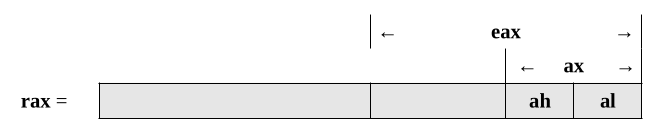 |
As shown in the diagram, the first four registers, rax, rbx, rcx, and rdx also allow the bits 8-15 to be accessed with the ah, bh, ch, and dh register names. With the exception of ah, these are provided for legacy support.
- Legacy Support means the
ah-dhregisters are kept in modern CPUs so old software still runs.- The registers
ah,bh,ch, anddhwere originally introduced in 16-bit x86 processors (like the Intel 8086). - In those early processors, registers like
ax(accumulator) were 16-bit, andahaccessed the high byte (bits 8–15) ofax, whilealaccessed the low byte (bits 0–7). - These “high-byte” registers (
ah,bh, etc.) still exist on modern 64-bit CPUs, only for compatibility with old code.
- The registers
- Don’t worry about using
ah,bh,ch,dhmodern Assembly programming rarely uses them because:- Newer instructions and compilers don’t rely on them.
- Using 32-bit or 64-bit registers like
eax,raxis more common and cleaner. - The
ah–dhregisters can cause conflicts with some modern instruction encodings.
2. Stack Pointer Register (RSP)
| 64-bit | 32-bit | 16-bit | 8-bit | Purpose / Notes |
|---|---|---|---|---|
| RBP | EBP | BP | BPL | Base pointer (stack frame reference) |
rsp, is used to point to the current top of the stack. The rsp register should not be used for data or other uses. |
3. Base Pointer Register (RBP)
| 64-bit | 32-bit | 16-bit | 8-bit | Purpose / Notes |
|---|---|---|---|---|
| RBP | EBP | BP | BPL | Base pointer (stack frame reference) |
rbp, is used as a base pointer during function calls. The rbp | ||||
| register should not be used for data or other uses. |
4. Instruction Pointer Register (RIP)
| 64-bit | 32-bit | Use |
|---|---|---|
| RIP | EIP | Holds address of next instruction to execute |
There is a special register, rip, which is used by the CPU to point to the next instruction to be executed. Specifically, since the rip points to the next instruction, that means the instruction being pointed to by rip, and shown in the debugger, has not yet been executed. This is an important distinction which can be confusing when reviewing code in a debugger. |
5. Flags Register
| 64-bit | 32-bit | Use |
|---|---|---|
| RFLAGS | EFLAGS | Contains status flags (zero, carry, overflow, sign, etc.) after operations |
So RFLAGS registers contains many sub-flags as follow: |
| Flag | Bit | Full Name | Set When… |
|---|---|---|---|
| CF | 0 | Carry Flag | Used to indicate if the previous operation resulted in a carry. |
| PF | 2 | Parity Flag | Used to indicate if the last byte has an even number of 1’s (i.e., even parity). |
| AF | 4 | Adjust Flag | Used to support Binary Coded Decimal operations. |
| ZF | 6 | Zero Flag | Used to indicate if the previous operation resulted in a zero result. |
| SF | 7 | Sign Flag | Used to indicate if the result of the previous operation resulted in a negative (most significant bit is 1) |
| DF | 10 | Direction Flag | Used to specify the direction (increment or decrement) for some string operations. |
| OF | 11 | Overflow Flag | Signed overflow occurred |
Let’s understand RFLAGS with example: |
mov eax, 5
cmp eax, 5    ; compares: sets ZF because 5 - 5 = 0
je equal      ; jumps to 'equal' if ZF is set
Now here:
mov eax, 5- Puts the value
5into registerEAX.
- Puts the value
cmp eax, 5- Performs:
eax - 5. - It updates the
RFLAGSregister, specifically
- Performs:
| Flag | Meaning | Value |
|---|---|---|
| ZF | Zero Flag | 1 (because 5 - 5 = 0) |
| SF | Sign Flag | 0 (result not negative) |
| OF | Overflow Flag | 0 (no signed overflow) |
| CF | Carry Flag (unsigned borrow) | 0 (no borrow) |
je equalje= “Jump if Equal” = jump if ZF (Zero Flag) == 1- So it reads the ZF bit from
RFLAGS. - Since ZF = 1 (from the
cmp), the jump is taken.
So, we don’t access RFLAGS directly in most code. Instead, conditional jump instructions (like je, jg, jl, jb) rely on it under the hood.
6. XMM Registers
There are a set of dedicated registers used to support 64-bit and 32-bit floating-point operations and Single Instruction Multiple Data (SIMD) instructions. The SIMD instructions allow a single instruction to be applied simultaneously to multiple data items. Used effectively, this can result in a significant performance increase. Typical applications include some graphics processing and digital signal processing.
The XMM registers as follows:
| Register Name | Size | Purpose |
|---|---|---|
xmm0 to xmm15 (or xmm31*) | 128 bits (16 bytes) | SIMD operations, floating-point, packed integer data |
ymm0 to ymm15 | 256 bits (AVX) | Extended version of XMM registers |
zmm0 to zmm31 | 512 bits (AVX-512) | High-performance SIMD |
7. Segment Registers
Used historically for segmented memory; less relevant today but still exist.
| Register | Name | Typical Use |
|---|---|---|
| CS | Code Segment | Instruction fetching (set automatically) |
| DS | Data Segment | Default for most data accesses |
| SS | Stack Segment | Used for stack operations (push/pop/call) |
| ES | Extra Segment | Older string ops (e.g. movs, stos) |
| FS | Extra Segment 2 | Thread-local storage, Windows TIB/TEB |
| GS | Extra Segment 3 | Used by OS/kernel (e.g. Linux TLS, KASLR) |
| Segmentation is mostly disabled in 64-bit mode, FS and GS are still functional and used in: |
- Linux:
GSpoints to per-CPU data structures or TLS (Thread Local Storage) - Windows:
FSpoints to the Thread Information Block (TIB)
8. Control Registers
Control Registers are special CPU registers used to control and configure low-level operations of the processor such as enabling paging, switching privilege levels, or setting up virtual memory.
These are used by the OS kernel and hypervisors, not in typical application-level code.
| Register | Name | Purpose |
|---|---|---|
| CR0 | Control 0 | Enables protected mode, paging, and other features |
| CR2 | Control 2 | Stores the faulting address on a page fault |
| CR3 | Control 3 | Holds the Page Table Base Address |
| CR4 | Control 4 | Enables advanced CPU features (SSE, PAE, etc.) |
| CR8 | Control 8 | Task Priority Register (x86-64 only, for APIC/interrupts) |
CR1, CR5-CR7 are reserved or unused.
CR0 - Core CPU Control
Enables/disables basic processor features.
| Bit | Flag | Meaning |
|---|---|---|
| 0 | PE | Protected Mode Enable |
| 31 | PG | Paging Enable |
| 2 | TS | Task Switched |
| 3 | ET | Extension Type (387 math coproc) |
| 5 | NE | Numeric Error (for FPU) |
| 16 | WP | Write Protect (kernel paging) |
If CR0.PG is set, virtual memory (paging) is active.
CR2 - Page Fault Linear Address
- When a page fault occurs, CR2 contains the virtual address that caused it.
- OS reads CR2 to understand which memory access failed.
mov rax, cr2 ; get the address that triggered the page faultCR3 - Page Table Base Register (PTBR)
- Holds the physical address of the Level 4 page table (in x86-64).
- Changing CR3 switches to a new virtual address space (used in context switching).
mov cr3, rax ; switch page tablesCR4 - Feature Enable Flags
Enables advanced features.
| Bit | Feature | Purpose |
|---|---|---|
| 5 | PAE | Physical Address Extension |
| 9 | OSFXSR | Enables SSE instructions |
| 10 | OSXMMEXCPT | Enables SSE exception handling |
| 7 | PGE | Global pages |
| 12 | SMAP | Supervisor Mode Access Prevention |
CR8 (x86-64 only)
- Controls the priority of interrupts.
- Mostly used in APIC interrupt controllers.